My books
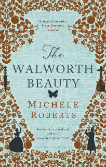 |
The Walworth Beauty (Bloomsbury, 2017)
2011: When Madeleine loses her job, she decides to leave her riverside flat in the heart of the City, where history never feels far away, and move to Apricot Place. Yet here too, in this quiet South London cul-de-sac, she senses the past encroaching, a shifting in the atmosphere.
1851: Family man Joseph Benson is employed by Henry Mayhew to research his articles on the working classes. Roaming the Southwark streets, and tempted by the brothels' promises of pleasure, Joseph struggles with his assignment. Seeking help, he is drawn to Apricot Place, where the enigmatic Mrs Dulcimer resides.
As these two stories unfold, they begin to entwine, and the ghosts of the city's past erupt in the present. A haunting tale of desire and exploitation; this is Michèle Roberts at her intoxicating best.
To be published 20th April 2017
pre-order from amazon |
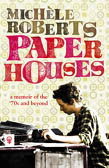 |
Paper Houses
A fledgling writer taking a leap into radical politics, Michèle Roberts finds alternative homes, new families and lifelong friendships in the streets and houses of dynamic 1970s London. As she wanders through the city she loves, her journeys inspire and merge with inner ones. London is marching, creating and performing – and Michèle Roberts is at the very heart of it.
From Spare Rib to publishing her first book, Paper Houses is in part the story of finding a space - and learning to share it – in houses from Holloway and Peckham to Regent's Park and Notting Hill Gate. Accounts of communal living fill dozens of colourful notebooks, but her all-consuming longing to write also causes conflict in her relationships and financial issues that lead her to a nomadic urban existence. Love, feminist ideals and the legacy of a Catholic upbringing don't always sit so happily together, be it in London or on her escape adventures in Bangkok, Bali, Italy …
Paper Houses provides both a powerful rendering of a time and an insight into the mind of a unique and talented writer.
buy
at amazon |
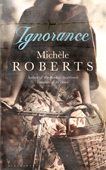 |
Ignorance (London: Bloomsbury Publishing, 2012)
After every war there are stories that are locked away like bluebottles in drawers and kept silent. But sometimes the past can return: in the smell of carbolic soap, in whispers darting through a village after mass, in the colour of an undelivered letter.
Jeanne Nerin and Marie-Angèle Baudry grow up, side by side yet apart, in the village of Ste Madeleine. Marie-Angèle is the daughter of the grocer, inflated with ideas of her own piety and rightful place in society. Jeanne's mother washes clothes for a living. She used to be a Jew until this became too dangerous. Jeanne does not think twice about grasping the slender chances life throws at her. Marie-Angèle does not grasp; she aspires to a future of comfort and influence.
When war falls out of the sky, along with it tumbles a new, grown-up world. The village must think on its feet, play its part in a game for which no one knows the rules. Not even the dubious hero with 'business contacts' who sweeps Marie-Angèle off her feet. Not even the reclusive artist living alone with his sensual, red canvases. In these uncertain times, the enemy may be hiding in your garden shed and the truth is all too easily buried under a pyramid of recriminations.
Michèle Roberts's new novel is a mesmerising exploration of guilt, faith, desire and judgment, bringing to life a people at war in a way that is at once lyrical and shocking.
buy
at amazon
Reviews
'I devoured it. It's terrifically good ... utterly engrossing and impossible to stop reading. A beautiful book'
Hermione Lee
'Michéle Roberts is a fantastic writer'
Guardian
'I could not put it down: it's a marvellous piece of work'
Carmen Callil, author of Bad Faith
'I read it solidly on the plane, in our room, in the sun, wherever. I really loved it'
Victoria Glendinning
'Moving and involving'
The Times
'Wonderfully sensuous'
Easy Living
'A powerfully immersive and moving novel'
Independent on Sunday
'Powerful and lyrical'
Daily Mail
'Roberts' description of heartache, loss and guilt is breathtaking. Simply brilliant'
Irish Examiner
'Vividly sensuous, highly metaphorical, full of textures, sounds and smells. It is striking stuff'
Sunday Times |
 |
A
Piece of the Night (London: The Women's Press, 1978)
Julie tries hard to be the dutiful daughter, the perfect wife and
mother, but underneath she knows the darker, more passionate side
of her psyche is struggling to be free. Among so many conventional
female roles, can Julie invent one which is truly her own? A landmark
classic of modern fiction, Michèle Roberts's first novel looks
at women's search for 'stories that will not put them to sleep'.
buy
at amazon |
 |
The
Visitation (London: The Women's Press, 1983)
Helen's love affairs begin with questions about how men and women
love each other and are divided from each other, and turn into journeys
towards knowledge. Using the image of the twins, The Visitation
explores gender difference, female sexuality, the quest for honesty
and creativity, the clash between making art and getting politically
involved. This painful and often funny novel captures young women's
struggles to love with integrity.
buy
at amazon |
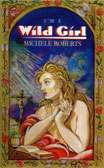 |
The
Wild Girl (London: Methuen, 1984)
This daring novel takes on the misogyny at the heart of historical
Christianity and re-writes the New Testament. Embodying a fifth Gospel,
by Mary Magdalene, The Wild Girl leaps over the religion-induced
splits in women's psyches and reintegrates creativity, sexuality,
maternity, power. Mary Magdalene is no longer the repentant whore
of legend but a prophet, heretic, and mystic, the lover of Jesus,
a heroine who envisions a Christianity that puts women at its heart.
buy
at amazon |
 |
The
Book of Mrs Noah (London: Methuen, 1987)
Visiting Venice and longing for a child in a marriage that seems to
be sinking like the beautiful city she wanders through, a woman imagines
a fantastical ark. Here, not animals but writers and books are the
precious cargo. The wickedly funny and irreverent Sibyls spin their
tales to God the Father (otherwise known as the Gaffer- one who makes
gaffes). The stories form a journey through the ages of women's experience
and Mrs Noah herself has much to learn.
buy
at amazon |
 |
In
the Red Kitchen (London: Methuen, 1990)
Victorian England, ancient Egypt and contemporary London fit together
like pieces in a jigsaw. Intertwined narratives by different women
plait the centuries together and take us time-travelling. Can we know,
hear, see the dead? How do their stories reach us? Flora Milk, a young
nineteenth-century medium, haunted by an Egyptian Queen who becomes
a Pharoah, haunts in her turn the old terraced house that Hattie is
trying to restore. Secrets leak from the walls. Lies drive one woman
towards madness. The local cemetery holds the clues.
buy
at amazon |
 |
Daughters
of the House (London: Virago: 1992)
Therese and Leonie grow up in post-war Normandy at a time when France
is struggling to come to terms with the legacy of war, from collaboration
to loss. Villagers draw a veil over the past, graves in the woods
are forgotten, and even the family farmhouse, occupied during the
war, hides secrets. The two girls pick their way through adults' silences
and evasions, but, when they each have a vision in the woods, they
find themselves at variance with each other. Whose story will be believed?
Whose version of the truth will prevail?
buy
at amazon |
 |
Flesh
and Blood (London: Virago, 1994)
This vividly experimental novel breaks the traditional line of narrative
in two, to demonstrate the pain of a broken relationship between mother
and daughter. The reader mends this split by reading the halved stories
and putting them back together, following Freddy's quest backwards
through history and then forwards again. Reading becomes, entertainingly,
like doing up a zip; and the characters certainly enjoy slipping in
and out of each other's clothes and stories.
buy
at amazon |
 |
Impossible
Saints (London: Little, Brown, 1997)
Josephine has written her official Life to placate the authoritarian
Inquisitors, but her real thoughts, her complex visions of her new
convent and Rule, remain hidden. The Church cannot tolerate women
who are both holy and sexy. Josephine's full story will die with her.
Her niece Isabel, griefstricken and desperate to find her own way,
begins to collect leftover scraps of Josephine's writing, her relics.
She pieces together a new version of Josephine that doesn't fit the
official one. Throughout Josephine's story are strung fantastical,
impossible and irreverent 'lives' of re-imagined saints, like the
golden beads on the rosary Josephine has left to Isabel to guide her.
buy
at amazon |
 |
Fair
Exchange (London: Little, Brown, 1999)
This witty homage to romantic historical fiction operates to subvert
it. Inspired by the lives of feminist Mary Wollstonecraft and radical
poet Wordsworth, it looks at how the French Revolution put into question
traditional expectations around love, romance, education and the upbringing
of children. The novel is also inspired by thrillers: the gripping
mystery of identity at its heart is revealed only in the last few
pages.
buy
at amazon |
 |
The
Looking Glass (London: Little, Brown, 2000)
Genevieve is a homeless orphan, very much in the tradition of Jane
Eyre, searching for a home even as she is driven out of one house
after the other. She finds shelter in the household of a poet, Gerard,
a figure inspired by the biographies of both Flaubert and Mallarme.
All the women in Gerard's life start to compare stories, with startling
and subversive results. Set in Normandy just before the First World
War, the novel explores the relationship of history to myth and how
these come together in secret, subterranean worlds.
buy
at amazon |
 |
The
Mistressclass (London: Little, Brown, 2002)
What happens when a young female student falls in love with a charismatic,
older male teacher? Imbalances of power are at the heart of this troubling
novel, which compares a contemporary love triangle with the situation
of Charlotte Bronte vis-à-vis her tutor in Brussels, Monsieur
Heger. Charlotte writes passionate letters from beyond the grave.
Vinny, in the present, is haunted by the ghosts of London's writers.
Masculine sexuality and masculine vulnerability, in the shape of Adam,
Vinny's ex-lover, are held up to the light and examined.
buy
at amazon |
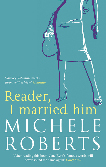 |
Reader,
I Married Him (London: Little, Brown, 2005)
This comic romantic thriller, frivolous on the surface, is concerned
with perennial questions of metamorphosis. Who is Aurora? Every time
she gets married, she changes into a different person. So far, alas,
she has lost three husbands. Off she goes to Italy, to visit her old
friend Leonora. But fate, in the shape of the charismatic Father Michael,
her flamboyant stepmother Maude, and a gay museum-director, soon catches
up with her. In this comedy of misrecognition, Aurora finally has
to unveil herself and face the truth.
|
|
Ignorance (London: Bloomsbury Publishing, 2012)
After every war there are stories that are locked away like bluebottles in drawers and kept silent. But sometimes the past can return: in the smell of carbolic soap, in whispers darting through a village after mass, in the colour of an undelivered letter. Jeanne Nerin and Marie-Angèle Baudry grow up, side by side yet apart, in the village of Ste Madeleine. Marie-Angèle is the daughter of the grocer, inflated with ideas of her own piety and rightful place in society. Jeanne's mother washes clothes for a living. She used to be a Jew until this became too dangerous. Jeanne does not think twice about grasping the slender chances life throws at her. Marie-Angèle does not grasp; she aspires to a future of comfort and influence. When war falls out of the sky, along with it tumbles a new, grown-up world. The village must think on its feet, play its part in a game for which no one knows the rules. Not even the dubious hero with 'business contacts' who sweeps Marie-Angèle off her feet. Not even the reclusive artist living alone with his sensual, red canvases. In these uncertain times, the enemy may be hiding in your garden shed and the truth is all too easily buried under a pyramid of recriminations. Michèle Roberts's new novel is a mesmerising exploration of guilt, faith, desire and judgment, bringing to life a people at war in a way that is at once lyrical and shocking.
buy
at amazon |
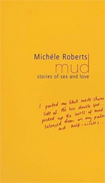 |
mud
A jilted lover skirts the edges of time and place as she walks the streets of London at night; a woman returns to the scene of her honeymoon without her husband; a bereft daughter traces her relationship with her mother as she slowly packs up a house in the afternoon of death.
In this brilliant collection of intimate and intense stories, Michèle Roberts takes us to nineteenth-century Venice, 1970s England, modern-day France and beyond. Here are Tristram and Isolde with a twist; George Sand, sick in Venice with her unfaithful lover; and the bitter maid taking care of young Adèle-both forced out of Rocherster's home to make way for the passions of Jane Eyre...
With her subversive, often witty exploration of women's desires, memory, grief, love and betrayal, Michèle Roberts demonstrates once again why she remains one of Britain's most invigorating writers.
buy
at amazon |
 |
During
Mother's Absence (London: Virago, 1993)
When the cat's away the mice will play. This collection of short stories
looks at absent mothers and the legacies they bestow for good and
bad.
A mother grieves over the shoes her runaway daughter has left behind,
and painfully recognises her part in that daughter's flight. A single
mother escapes to France for food and sex. A teenage girl whose mother
has died tracks her in dreams. All the stories explore the figure
of the mother as a muse for artists.
buy
at amazon |
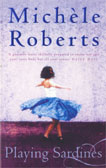 |
Playing
Sardines (London: Virago, 2001)
This collection of short stories circles around classic themes of
sex, desire and food. The eponymous tale packs a whole life into the
image of a tin of sardines. Mallarme puts on drag, with amazing results.
An obsessional woman reveals the murderous lust concealed by her bid
to stay slim. A celebrity chef is stalked by a besotted fan whose
greed knows no bounds. Pornography meets children's stories in a tale
of ripped bodices and derring-do.
buy
at amazon |
 |
The Mirror of the Mother (London:
Methuen, 1986) |
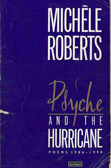 |
Psyche and the Hurricane (London:
Methuen, 1991) |
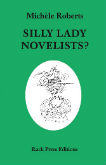 |
Silly Lady Novelists (Rack Press Poetry)
What kind of novels should women write? Should anyone be prescribing the answer to such a question? In a lively and polemical response to George Eliot's famous Westminster Review essay of 1856 "Silly Novels by Lady Novelists", novelist, poet and critic Michèle Roberts offers a challenging examination of current debates around fiction and sex.
order from rack press |
Food, Sex and God – on Inspiration and Writing (London: Virago, 1988)
This tongue-in-cheek title refers to Michèle Roberts's response when
asked what she writes about. These essays explore creativity, look at the
work of writers she admires, ruminate on questions of form, the canon, tradition,
inspiration and the writing process.
The Journeywoman (premiered Mercury Theatre, Colchester,
1987)
Child Lover (premiered Tramway Theatre, Glasgow, 1993)
Ma Semblable Ma Soeur (Channel 4 TV, 1990)
with Astra Blaug, Alison Fell, Sheila Rowbotham and Michelene Wandor:
Cutlasses and Earrings (London: Playbooks, 1977)
with Alison Fell, Stef Pixner, Tina Reid and Ann Oosthuizen:
Licking the Bed Clean (London: Teeth Imprints, 1978)
Smile Smile Smile Smile (London: Sheba, 1980)
With Judith Kazantzis and Michelene Wandor:
Touch Papers (London: Allison & Busby)
with Zoe Fairbairns, Sara Maitland, Valerie Miner and Michelene Wandor:
Tales I Tell My Mother (London: The Journeyman Press,
1978)
More Tales I Tell My Mother (London: The Journeyman
Press, 1987)
With Kathy Acker, Leslie Dick, Zoe Fairbairns, Alison Fell, Sara Maitland
and Agnes Owens:
The Seven Deadly Sins (London: Serpent's Tail, 1988)
The Seven Cardinal Virtues (London: Serpent's Tail,
1990)